My Garden Story
Welcome to "My Garden Story" by Jane Allen
A passionate self-taught gardener living in the Southern Highlands of NSW. Join her for tips and inspiration to help you cultivate and grow a thriving garden!
Article 14 -Blue and Yellow flowers


Blue Flowers
Of all the flowers in my garden, the blues give me most pleasure and are amongst the easiest, and hardest, to grow. The most coveted one being the Himalayan blue poppy, Mecanopsis. The colour is sublime and it is notoriously difficult to grow, but I tried, twice. There was a nursery in Tasmania which sold seedlings, so I ordered a couple and popped them in. I found a damp, sheltered spot I thought would be cold enough – we occasionally get snow here in the winter – and looked at them hopefully every day. Nothing happened, and then they died. Undeterred, I tried again the following year. Same thing. Then the nursery closed so that was the end of that. I once saw a single poppy in a very sheltered garden not far from here, but I didn’t know what it was. Then I saw a clump at Chatsworth in a dark corner with wet soil and overhanging hedge. For the rest I have to rely on pictures, other peoples.
Things I can grow and are rabbit proof are mostly perennials. I do have a few pots of small things like blue hyacinths on the terrace, but for sheer impact in the garden I think swathes of forget-me-nots are hard to beat. The problem is the self-seeding. Over the years I have implored gardeners to pull them out before they set seed, but most are reluctant, not wanting to have their legs covered with sticky little seeds that cling tightly. So, I bought cheap painters overalls and did it myself, throwing the overalls in the bin at the end. It is never possible to get them all but there are now a couple of controlled patches, and the rest have been harvested, poisoned or heavily mulched.
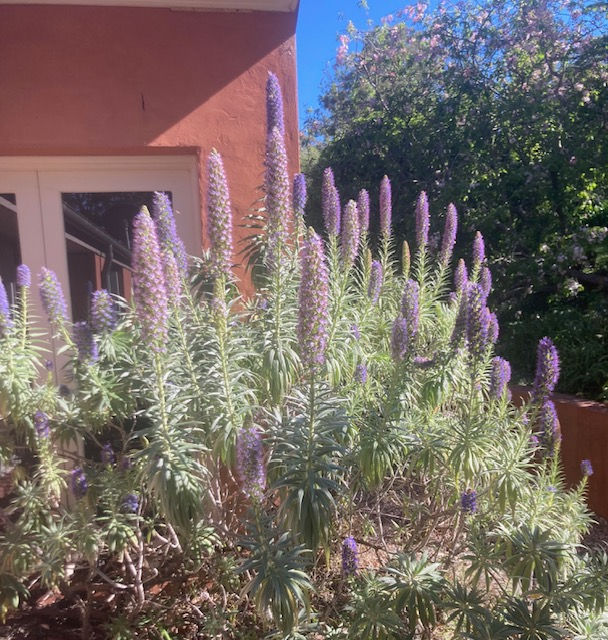
Other blue flowers that make a statement are the Spanish bluebells planted in rings around several trees. They can also spread alarmingly fast and must be dug to be controlled. My current favourite is the award winning blue geranium Rozanne. It is long lasting and a wonderful colour in large or small spaces. It likes almost all positions in the garden and looks after itself, disappearing completely in the winter. Then there are several different blue irises which can fade over time. A blue convolvulus cascades over a wall, grape hyacinths down the drive and patches of ajuga which grows where nothing else will. The street border is agapanthus, planted many years before I came here, and two big clumps of echium up against the house which complement the terra cotta well. There is also a bell flowers, and finally, a ground cover of plants with strappy leaves and a small, bright blue flower I have never been able to identify. All I know is that it was planted by the landscaper 20 years ago and is still going strong. I have twice tried to grow a ceanothus, but it doesn’t like it here. My sister in England had a huge one growing beside her garage and I thought it spectacular, but I must admit I have never seen one in a local garden.
Yellow Flowers
Yellow is a difficult colour in art and in nature. Even a small amount draws the eye and too much can overwhelm the surrounding plants. I love it, but again it is more disaster than triumph in my garden. A lovely Magnolia Elizabeth succumbed to the big wet year, I had a wonderful yellow rose called C’mon Lleyton which had to be moved when the builders came and is no longer available as a rose but has morphed into an iris. However, David Austin’s Golden Celebration does very well. A Mollis azalea in a pot was shy to flower so we moved it under the oak tree, where it burst into flower. Then somebody (not me) decided to plant it in the garden where it flowered one last time and then died. Too many moves, I think. A rare yellow fritillaria flowered once and though I cared for it tenderly it never reappeared. The Cootamundra wattle, daffodils great and small, calla lilies, iris and liliums do well, as do golden tulips in a pot. What was to be the star of the show, Rudbeckia – also known as cone flower and black-eyed Susan – met a sad end. I had seen pictures of it in English garden magazine, found out what it was an lo and behold, the rest of Australia discovered it at the same moment. A magnificent swathe appeared in the local park and it appeared in pots everywhere. I bought seedlings and, having a premonition, covered them with cloches to start with. When I thought they were big enough to cope, I removed them and overnight they were eaten to the ground by rabbits. I found masses in pots at the local market and bought two with about a dozen flower heads on each. They survived until the flowers faded, then they, too were eaten. Knowing that they are mostly perennial, I hoped they would appear again, and I would protect them more aggressively, but they never have. I could go on buying big pots in flower, but why should I feed the damn rabbits?
Next time, Flowers in Art.